Join 100+ readers in learning the Art of Rhetoric: Timeless Techniques of Persuasion that helped history's giants navigate courtroom politics, win wars, and build civilisations.
Share
No, Rhetoric isn't just "Glorified Sales" ft. House of the Dragon and Lorenzo de Medici
Published 11 months ago • 11 min read
The Rhetorician
Issue #23
No, Rhetoric isn't just "Glorified Sales" ft. House of the Dragon and Lorenzo de Medici
And How to Argue Without Subordinating Yourself
Jacaerys Targaryan and Cregan Stark, HotD Season 2
Here’s a question that’s probably crossed your mind: Isn’t rhetoric just fancy sales? After all, they share the same toolkit. The strategic hook. Objection handling. Emotional appeals. Building credibility. Even the pacing and tonality look identical.
I get it. The similarities are real.
But here’s what you need to understand: the difference between sales rhetoric and classical rhetoric is the difference between closing a deal and commanding a room.
And if you’re climbing the corporate ladder, trying to influence without authority, negotiating with executives who don’t report to you, this distinction isn’t academic.
It’s the difference between being taken seriously and being politely ignored.
Why They Look The Same
Sales borrowed from rhetoric, inheriting a toolkit forged over millennia. What modern training calls “the hook” is exordium in classical rhetoric. Objection handling descends from refutatio, the systematic dismantling of counterarguments. Building rapport draws from ethos, the establishment of credibility and character. Creating urgency echoes kairos, the art of the opportune moment.
Every sales technique you’ve learned has roots in a 2,500-year-old tradition designed for something far grander than moving product.
Rhetoric was forged to govern city-states, to negotiate treaties between kingdoms, to unite fractious peoples, to shape the destiny of nations. It was the art by which civilization perpetuated itself, the bridge between private wisdom and public action.
From Wolf of Wall Street (2013)
Sales took that ancient toolkit, stripped it down to what could be taught quickly, and optimized it for a single use case: convincing strangers to exchange money for goods, at scale, in transactions you’ll never revisit.
That’s not a criticism. It’s simply a different game entirely.
Classical Rhetoric in Action
To see this distinction in practice, watch Lorenzo de’ Medici address Florence after surviving an assassination attempt that killed his brother. He must turn personal grief into civic unity, convince an entire city that the attack wasn’t just on his family but on Florence itself.
Watch the scene before continuing. It’s two minutes that will reframe everything that follows:
Notice what he doesn’t do: he doesn’t list benefits, handle objections, or create artificial urgency. He reminds the Florentines of who they are and what they value, and lets those values demand they stand with him.
This is rhetoric in its highest form: words as statecraft, eloquence as sovereignty. Not selling, but reminding. Not convincing, but evoking what the audience already believes about themselves.
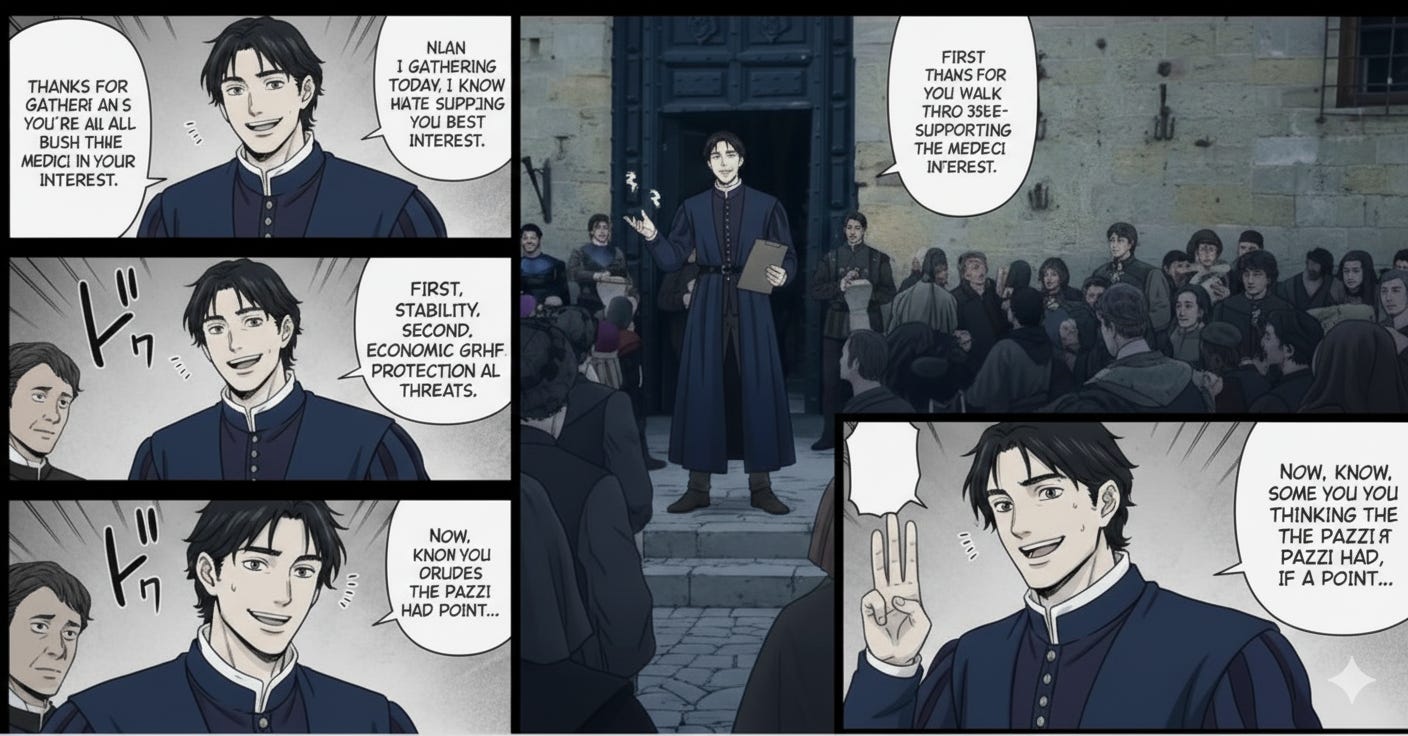
Now imagine if Lorenzo had spoken like a salesman: “Thanks for gathering today, I know you’re all busy. Let me walk you through three reasons why supporting the Medici is in your best interest. First, stability. Second, economic growth. Third, protection from external threats. Now, I know some of you might be thinking the Pazzi had a point...”
He’d have been torn apart before finishing his first sentence. You don’t sell to people whose support you need as a matter of honor and identity. You remind them of who they are.
The Real Distinction
Sales rhetoric assumes: “I need you more than you need me, so I must convince you.”
Sales speaks up to power. Classical rhetoric speaks across to power.
The same principle applies in every boardroom where real power is negotiated.
Walk into a high-stakes meeting and say: “Thanks for your time. Let me show you three benefits of this approach. First, we reduce cycle time by 40%. Second, our team’s excited. Third, we’ve built in flexibility. Now, I know you might think this sounds expensive...”
You’ll never be in that room again. Not because your content was wrong, but because you’ve announced yourself as a supplicant who needs them more than they need you.
Now imagine saying instead: “There are two kinds of companies right now: those optimizing for next quarter, and those building for 2030. We’re the latter. That’s not for everyone. But if you’re thinking on that horizon, we should talk about what we’re seeing.”
Similar positions. Different frame entirely. You’re evaluating fit, not begging for approval.
This matters everywhere you need influence without authority: convincing leadership to fund your project, getting other teams to prioritize your work, negotiating with stakeholders who don’t report to you. Sales rhetoric marks you as junior. Classical rhetoric positions you as a peer with strategic vision worth hearing.
Now let’s see how this plays out in a negotiation between two parties of roughly equal power, where both must preserve face and neither can afford to appear desperate.
The Wall in the North: A Masterclass in Diplomatic Rhetoric
Some context: In House of the Dragon, the royal Targaryen family has fractured into two factions competing for the Iron Throne. Civil war is inevitable. Prince Jacaerys Velaryon, heir to one faction, has flown north to secure military support from Lord Cregan Stark, the semi-autonomous ruler of the North, the largest and most independent province in the Seven Kingdoms.
Jace needs troops. Cregan owes allegiance to the crown. On paper, this should be simple.
But watch what actually happens. This is a negotiation between two men who both understand that how you ask determines what you receive, and that the appearance of desperation is more costly than rejection itself.
Watch the scene before continuing. It’s five minutes, and every line is doing something:
This is a rhetorical game of chess, and every move betters or worsens your position. Let me walk you through it, because this scene is worth studying line by line.
Cregan’s Opening Gambit: Defining Duty
Cregan opens with philosophy:
“Duty is sacrifice. It eclipses all things, even blood. All men of honor must pay its price.”
This is brilliant framing. Before Jace can even make his request, Cregan has:
Established himself as the voice of duty (not Jace)
Pre-empted any emotional appeals (”even blood”)
Set the terms: duty requires sacrifice, meaning Jace must sacrifice too
He continues:
“The North owes a great duty to the Seven Kingdoms. One older than any oath. Since the days of the First Men, we have stood as guardians against the cold and the dark.”
Notice what he’s done: acknowledged that duty exists, but anchored it in a timeframe that predates Targaryen conquest. His duty to the Wall is older than any oath to the crown. This is the rhetorical equivalent of trump cards—establishing a hierarchy of obligations where his priority supersedes Jace’s request.
Then he explains the tradition of sending men to the Watch:
“This is not a sentence but an honor. A duty embraced by all who serve the North. Even by mine own kin.”
He’s reframing what it means to serve, teaching Jace how to receive a lesser gift as if it were generous. And by mentioning his own kin, he’s establishing that he too pays this price—he’s not asking others to sacrifice what he won’t.
Finally: “The North must stand ready. Winter is coming.”
The Stark words themselves. A declaration that closes off discussion.
Jace Tests the Frame
Jace’s first move is subtle but pointed:
“Coming? What is this, then, that falls from the skies and shivers my bones?”
He’s gently mocking—pushing back on Cregan’s ominous warnings. If this isn’t winter, what is? It’s a small challenge to Cregan’s frame.
Cregan doesn’t take the bait:
“This is only a late summer snow, my prince. In winter, it will cover all you see, and all memories of warmth will be forgotten.”
He’s not defensive. He simply raises the stakes. You think this is cold? You know nothing. He’s establishing that Jace is out of his depth here, literally and figuratively.
Jace’s Counter-Move: Common Ground and Historical Authority
Jace tries to establish parity:
“It pleases me to think that over a century ago our ancestors treated in this very place. The Conqueror and the King in the North.”
He’s attempting to create shared history, peer status. We both have illustrious ancestors; we’re both heirs to greatness.
But Cregan immediately punctures this:
“You, at least, had the mercy not to threaten me with your dragon.”
Translation: “Your ancestor used force. You’re being more civilized, but we both know what backs your request. Don’t pretend this is a meeting of equals when you arrived on dragonback.”
This is where Jace deploys his most sophisticated move:
“Surely the great Torrhen Stark would have sooner died than bent the knee. Unless he believed the Conqueror could bring unity to the Seven Kingdoms.”
This is exquisite rhetoric. He’s simultaneously:
Honoring Stark courage (you’re not weak)
Suggesting Torrhen saw a greater purpose (unity)
Implying that same purpose is now at stake
Making submission to his mother a continuation of Torrhen’s wisdom, not a betrayal of it
He’s given Cregan a way to help that doesn’t wound his honor. That’s the hallmark of classical rhetoric: creating a path where the other party can give you what you want while maintaining their dignity.
Because a good argument isn’t about beating the other person into submission, but ensuring you get what you want. And the best way to get what you want is by elevating the other person, not berating them.
Cregan acknowledges: “You are right in that.”
Jace presses his advantage:
“That unity is now threatened. The realm will soon tear itself apart... if men do not remember the oath sworn to King Viserys and to his rightful heir.”
Now he’s moved from historical parallel to present obligation. The oath exists. Will you honor it?
Cregan’s Deflection
Cregan’s response is careful:
“Starks do not forget their oaths, my prince. But you must know that my gaze is forever torn between north and south. In winter, my duty to the Wall is even more dire than the one I owe to King’s Landing. I need my men here.”
Notice: he doesn’t refuse. He doesn’t say the oath doesn’t matter. He simply establishes competing obligations and frames his priority. He’s not rejecting Jace… he’s explaining the constraints. But he’s also not giving ground.
Jace’s Direct Challenge
This is where Jace makes his most aggressive move. He drops the subtle dance:
“Whilst your men guard against wildlings and weather, the Hightowers plan to usurp the throne. If my mother is to defend her claim to hold the realm united, she needs an army. War is coming to the whole of the realm, my lord. We cannot wage it without the support of the North.”
This is Jace’s riskiest moment. He’s essentially saying: “You’re worried about snow while a real war is brewing.” It’s direct. It’s almost dismissive of Cregan’s stated priorities. It could easily put Cregan on the defensive or, worse, offend him into refusal.
Notice he doesn’t say “because” or justify why his war matters more. He simply states facts and lets the weight of them sit. But he’s still exposed himself by being so direct.
The Death at the Wall
Cregan’s response is masterful. He doesn’t defend against the accusation. He doesn’t argue that wildlings and weather matter. Instead, he completely reframes what the Wall actually is.
“My father brought King Jaehaerys and Queen Alysanne to see the Wall. His Grace stood at this very outlook and watched as their dragons, the greatest power in the world, refused to cross it.”
Let that land. Dragons—the weapons that conquered all Seven Kingdoms—refused to cross. Whatever is on the other side frightens even them.
Then he delivers the line that reframes Jace’s entire challenge:
“Do you think my ancestors built a 700-foot wall of ice to keep out snow and savages?”
When Jace asks what it keeps out, Cregan pauses (rhetorically powerful) and answers with a single word:
“Death.”
This is the climax of his argument. His duty isn’t political but existential. While you’re worried about throne games, I’m holding back death itself. Your war is temporary. My war is eternal.
He’s taken Jace’s direct attack and turned it into proof that Jace doesn’t understand what’s actually at stake. He’s diminished Jace’s entire mission with one word, without ever appearing defensive.
The Compromise That Isn’t
Having established absolute frame control, Cregan makes his offer:
“I have thousands of graybeards who’ve already seen too many winters. They are... well-honed.”
Jace questions: “So they’re old?”
Notice Cregan doesn’t defend their age. He pivots:
“I can ready them to march at once.”
Speed becomes the virtue, not youth. He’s offering soldiers who are expendable (old), but framing them as prestigious (”well-honed”), making it sound generous (”thousands”), while keeping his real strength for the Wall.
Jace accepts: “If your graybeards can fight, the queen will have them.”
This isn’t surrender, but grace. He’s accepting less than he wanted, but doing so in a way that preserves dignity for both parties. He hasn’t begged. He hasn’t listed benefits. He hasn’t handled objections. He’s simply acknowledged what’s being offered and accepted it as adequate.
What Just Happened?
On the surface, Jace got troops. But look at what Cregan actually gave up: old men he was likely sending to the Wall anyway, soldiers who would have left his service regardless.
Cregan won the negotiation while appearing to compromise. He set the terms, maintained his priorities, and gave the minimum necessary to fulfill his oath—all while making it seem generous.
And critically, both men preserved face. Neither appeared desperate. Neither begged. Neither made the other feel superior or inferior.
That’s the art they’re practicing: negotiation between powers who cannot afford to subordinate themselves, who must find ways to cooperate while maintaining sovereignty.
The Pattern Beneath the Words
Let me make explicit what Cregan and Jace both understand intuitively:
In classical rhetoric:
You speak in declaratives, not questions (authority)
You use pauses and silence (confidence)
You anchor your argument to something bigger (legitimacy)
You hold your position, not chase others’
You frame the conversation itself
You never justify; only state
You create paths where others can give you what you want without losing face
In sales rhetoric:
You ask questions to understand their needs
You listen actively and adapt your pitch
You focus on benefits and ROI
You work within the buyer’s frame
You build rapport by entering their world
You demonstrate value through proof points
You reduce friction to make the decision easy
The difference isn’t just stylistic. It reflects fundamental assumptions about power, and how we negotiate reveals whether we are truly peers at all.
One thing this scene doesn’t show, but which is crucial: preparation. When you’re not allowed to ask questions to get information on the spot, and the negotiation is too high-stakes to fail, being prepared matters so much more. You must know the stated and unstated needs of the other party. You must know their situation better than they do. Jace clearly studied the North before arriving. He knows about Torrhen, about Stark honor, about the Wall. That preparation is what allows him to make the right moves in the moment.
Where This Lives Today
You might think this is purely historical, relevant to princes and popes but not to you.
You’d be wrong.
Every major partnership negotiation operates on these principles. Every investor pitch to top-tier VCs requires it. Every conversation between executives of roughly equal power uses this frame.
When Tim Cook negotiates with the CEO of Samsung, he’s not doing sales. When heads of state meet at summits, they’re not making sales calls. When you’re trying to convince your CEO to fund your initiative, sales rhetoric will mark you as junior.
The frame is everything. And Cregan and Jace understood that instinctively.
Why This Matters Now
We live in an age that worships efficiency, that reduces everything to scalable processes, that treats persuasion as a series of optimizable techniques.
But the highest forms of persuasion can’t be reduced to technique. They require something deeper: an understanding of power, status, and the subtle dance of sovereignty.
The humanists of Renaissance Florence understood this. They studied Cicero and Quintilian not to learn “communication skills” but to master the art of speaking as free men among free men, of persuading without subordinating, of negotiating without begging.
That art is still alive. It lives in boardrooms where companies are bought and sold. It lives in diplomatic cables that shape international relations. It lives anywhere that power meets power and must find terms of cooperation.
And it’s waiting for you to recognize it, name it, and claim it as your own.
You can speak, as Cregan spoke, from a position of unshakeable ground. You can make them want what you’re offering without appearing to sell. You can negotiate as a prince.
Which language will you speak?
P.S. - If this resonated with you, reply and tell me what negotiation you’re preparing for. I’m curious where you see these patterns playing out in your world.
Join 100+ readers in learning the Art of Rhetoric: Timeless Techniques of Persuasion that helped history's giants navigate courtroom politics, win wars, and build civilisations.
The Rhetorician Issue #24 Understanding Lord Henry's Influence on Dorian Gray “What of Art?—It is a malady.—Love?—An Illusion.—Religion?—The fashionable substitute for Belief.—You are a sceptic.—Never! Scepticism is the beginning of Faith.—What are you?—To define is to limit.” - Oscar Wilde, The Picture of Dorian Gray What can mere words achieve? Spoken by the right person in the right way… A Lot. Within days of meeting Lord Henry, the sweet and innocent Dorian Gray had descended into a path...
The Rhetorician Issue #24 The Doorway to Influence The Meeting That Changed the Room Monday morning. The team gathers—laptops open, coffee steaming. The manager rises to announce a new project. The first speaks: "We need to push harder this quarter. Targets are high. I expect everyone's best. Let's not fall behind." Silence. Nods. No fire. The second manager. Same project. Same targets. Different words: "These numbers look daunting. Last year, facing similar odds, this team exceeded every...
The Rhetorician Issue #17 Why Your Mind Freezes Under Pressure (And how to fix it) There’s a particular kind of professional nightmare that haunts even the most capable among us. Your VP asks what you think about the new roadmap. A client questions your recommendation mid-presentation. A stakeholder challenges your technical approach in front of the team. And suddenly — nothing. Your mind goes blank. I fear if I cannot think again, if my mind suddenly goes blank. It will be embarrassing. -...